Artist’s Corner – Kevin Baldwin: Composition No. 8

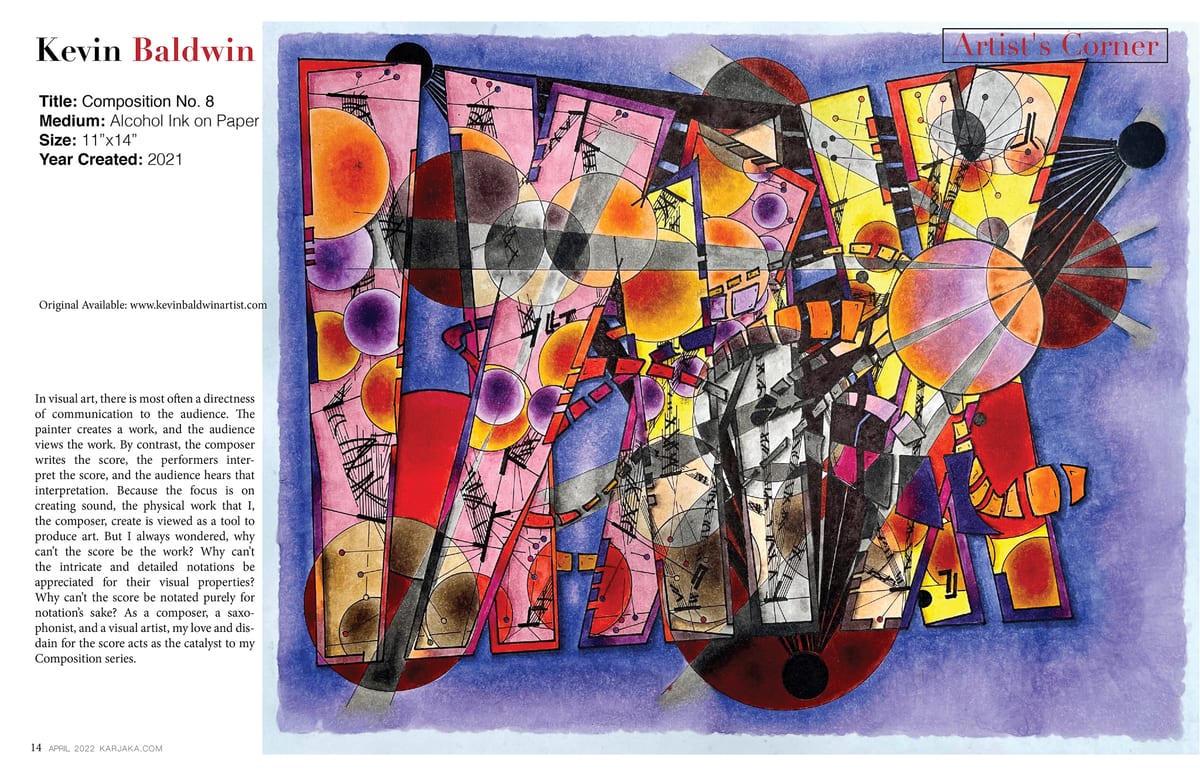
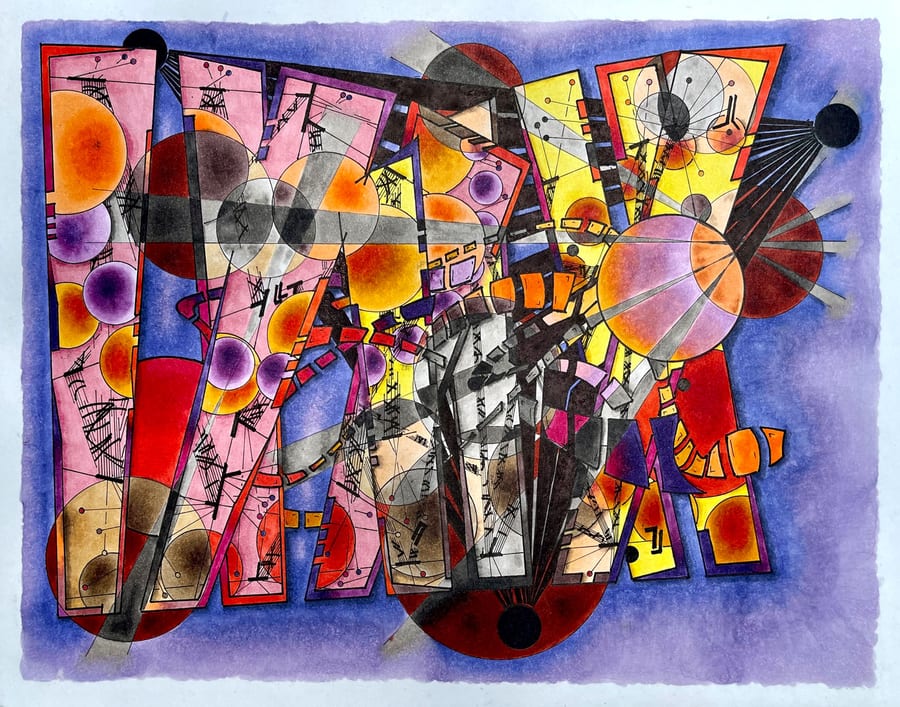
In visual art, there is most often a directness of communication to the audience. The painter creates a work, and the audience views the work. By contrast, the composer writes the score, and the audience hears that interpretation. Because the focus is on creating sound, the physical work that I, the composer, create is viewed as a tool to produce art. but I always wondered, why can’t the score be the work? Why can’t the intricate and detailed notations be appreciated for their visual properties? Why can’t the score be notated purely for notation’s sake? As a composer, a saxophonist, and a visual artist, my love and distain for the score acts as the catalyst to my Composition series.

Check This Out

Traveling Light with Bob Schwarz

I never thought I would be writing about myself and my sculptures when I was 90 years old. In my youth I couldn’t figure out why anyone would want to become 90, I changed my mind when I became 89. My journey into the world of art began some time ago. Nearly 60 years ago in fact. When I was visiting MOMA the sculptural work of the Russian Constructivist Naum Gabo stopped me in my tracks. I was fascinated by the way he weaved wire around vertical patterns to form parabolic shapes. Then and there I decided to try it myself and took it up as a hobby. Over the years I’ve become pretty good at it.

Artist’s Corner: Township Road 494

The score of a musical work is fascinating. As a composer, I spend hundreds of hours alone with a score to unearth and present the uniqueness of every sound. I consider the physicality of a sound, both in the depth of overtones and frequencies and in the most mi-nuscule human motions it takes to produce them. I consider texture, the harsh and grinding color of the cellist utilizing over-pressured bowing, and the intimate fragility of the flautist's unstable multi-phonic. I consider shape, from violent rhythmic gestures to light, lyrical flurries. I consider, how variations larger blocks made up of colors, texutres, layers, and rhythms work together to highlight every unique aspect of a sound. I consider the weight of each and every observance I make, and I ensure every mark in the score best reveals the essence of a sound.

Artist’s Corner – Kevin Baldwin: Professor Bad Trip, Lesson III

The score of a musical work is fascinating. As a composer, I spend hundreds of hours alone with a score to unearth and present the uniqueness of every sound. I consider the physicality of a sound, both in the depth of overtones and frequencies and in the most mi-nuscule human motions it takes to produce them. I consider texture, the harsh and grinding color of the cellist utilizing over-pressured bowing, and the intimate fragility of the flautist's unstable multi-phonic. I consider shape, from violent rhythmic gestures to light, lyrical flurries. I consider, how variations larger blocks made up of colors, texutres, layers, and rhythms work together to highlight every unique aspect of a sound. I consider the weight of each and every observance I make, and I ensure every mark in the score best reveals the essence of a sound.

All Categories

Best of 2024

From Issue 100 — KARJAKA's Best of 2024 - The Best is Yet to Come

LEAVE A REPLY

Please enter your comment!
Please enter your name here