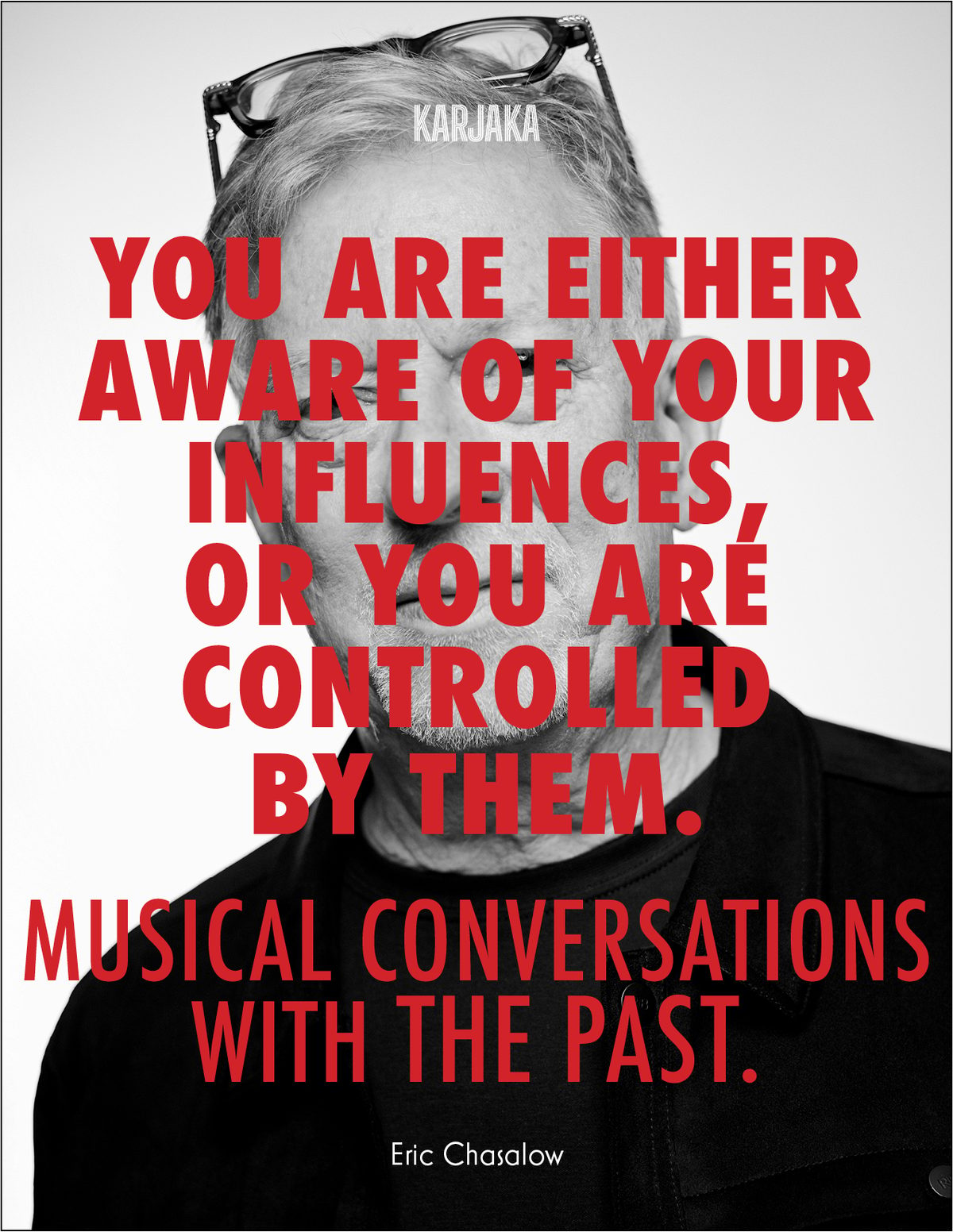
You are either aware of your influences, or you are controlled by them. Musical Conversations with the Past.
Very often these days, when I start to think about a new piece, I am confronted with a flood of questions: Will this piece be like the last, or will I push myself to discover some new way to express things this time? Do I just start to write and see where things lead, or should I force myself to do some pre-planning (which I hate to do)? Am I writing abstract music, or will the piece be “about” something? It is finding an answer to this last question that preoccupies me the most lately. For example, if I decide to write for a singer, the structure and character of the piece are going to be shaped in dialog with the meaning and expression of the text. But songs with texts are obviously about the subject of the text. There are other, less obvious ways in which a piece of music might be “about something”.

One of my mentors often said, “you are either aware of your influences, or you are controlled by them”. He meant that every composer is influenced by other music, whether willing to admit it or not, and to pretend otherwise is ignorant. I have thought a lot about that statement over the years and, ultimately, have found it helpful and freeing. If I just accept that influences are always there, then I had better get to know as much music as I can. It follows that this gives the unconscious the broadest range of sources to pull from. Furthermore, one can choose when to push the line between unconscious and conscious influence and create pieces that have an intentional “conversation with the past”, drawing on archival sources, deliberate musical references, or even quotations. The job then becomes to compose new contexts and points of view around and on old materials, transforming them and creating something new. This is, in fact a rich way of working that tracks the entire history of music, at least as far back as chant and as recent as “sampling”.
I find it deeply inspiring to consider all kinds of pre-existing materials – words, music, and recordings – depending on the piece I wish to write. My 1998 piece for live electric guitar and fixed media, ‘Scuse Me transforms Jimi Hendrix samples and musical motives into a new musical world with its own energy, totally apart from its famous source. My setting of five of John Berryman’s Dream Songs, for orchestra and fixed media has chunks of Bach woven into the orchestra at key dramatic moments to heighten the text without even really being heard. Other pieces, such as my recent, Muriel’s Songs, incorporate both historical musical models and memoir-based storytelling.

My grandmother, Muriel Gellert Chasalow (1903-2000) was born in Brooklyn and lived the rest of her life there and in New Jersey. In 2016, my Aunt Renee, her daughter, collected some stories that Muriel had written, assembling them into a book. I had heard or read some of these stories over the years, others were completely new and surprising to me. For my libretto, I extracted several dramatic situations from the book, composing a poem on each, often incorporating sentences from her stories wherever possible to capture her voice. The narrative thread starts with her memories at ten years old in 1913 and finishes with the death of my grandfather, Sam, her husband of fifty-six years, in 1985. My text adds a few especially colorful family stories that she had not written about, but that I had heard told by other relatives repeatedly over the years. The result is an intimate, intelligent and humorous personal reflection on living through key events of the Twentieth Century.
**Excerpts from Muriel’s Songs –**Copyright 2023 Eric Chasalow DBA Suspicious Motives Music (ASCAP)
1913
My mother’s mother was orthodox So very religious, she only spoke Yiddish…
But my parents were completely different. My father was a Tammany Hall Democrat And above all, worshiped The Brooklyn Dodgers.
1942
This song grounds the cycle in perhaps the defining experience of the century for my grandparents’ generation…World War II… I have written a direct parody (in the oldest sense of that word) on Purcell’s, When I am Laid in Earth, from Dido and Aeneas.
We suffered the shortages
We learned first aid We suffered the fear of air raids. We lowered the shades We sat and listened Every moment was a new threat
We suffered the fear We worried the night through We suffered the loss of loved ones We were resolved
Then, somehow, it was all over I swept the sand off of the summer carpet and out the door, But we would never Ever be the same again.
1959
Following a monumental effort, due to the post-war housing boom, my grandparents moved to West Orange. Grandpa returned to truck sales, founding Greater GMC truck sales, in Newark…bankrolled by the mob.
After the war We moved to a nice Part of West Orange Not the best, but very nice
One day Longie, who lived Just two-minutes away, But in a more exclusive neighborhood Was found by his wife In his own basement, hanged.
You had known him In younger years – A business acquaintance Back when he dated Jean Harlow And bought her that Diamond bracelet and A red Cadillac
We did not attend The funeral Though almost two-thousand people did, with an open casket and an abundance of flowers which really was surprising for a Jewish service though we heard later that no one, not even the rabbi, had been at all surprised…
1985
Toward the end of her book of stories, Muriel takes stock of what matters to her and realizes that the small interactions and daily accomplishments really count.
After being busy In the role of wife and partner For fifty-six years, Suddenly I am alone
I never tell anyone How pleased I am When they ask me to mend a sweater Or show me a picture And ask, “don’t you think This would look well on me?”
Just the other day I was extremely Satisfied that I was able to reset all of the clocks myself.

Musically speaking, each song in the cycle is a meditation on a different historical source and style. The challenge here was to embrace each source so completely that the new piece would move well beyond mere imitation to become transformative. With that as my goal and not wanting listeners to start playing “name that tune”, I have often been reluctant to mention specific sources. But the piece is written and I have either succeeded or failed, so here goes: Henry Purcell, Irving Berlin, JS Bach, Milton Babbitt, Disco, Latin Jazz and a less intentional bit of Mahler each make their appearance. As luck would have it, as I write, Talea Ensemble plans to present the New York premiere of Muriel’s Songs on April 23 at the YIVO Institute for Jewish Research so you can come and judge for yourself.
YIVO Institute for Jewish Research 15 W16th Street, NYC. (Information and tickets at yivo.com/Musical-Memoir)


Eric Chasalow
Eric Chasalow is a composer, sound artist, multi-instrumentalist, record producer, teacher, and advisor to non-profits. He is currently the Irving G. Fine Professor of Music at Brandeis University. In 2009, The Eric Chasalow collection was established in the Library of Congress. For inquiries and to purchase scores, contact Black Tea Music. (blackteamusic.com). Additional information may be found at www.ericchasalow.com.
All pieces by Eric Chasalow →